November 7, 2026
The Day After
Intangible heritage, culture, and belonging: the next step in the Reactivation Spiral of downtown São Paulo.
November 7, 2026
Intangible heritage, culture, and belonging: the next step in the Reactivation Spiral of downtown São Paulo.
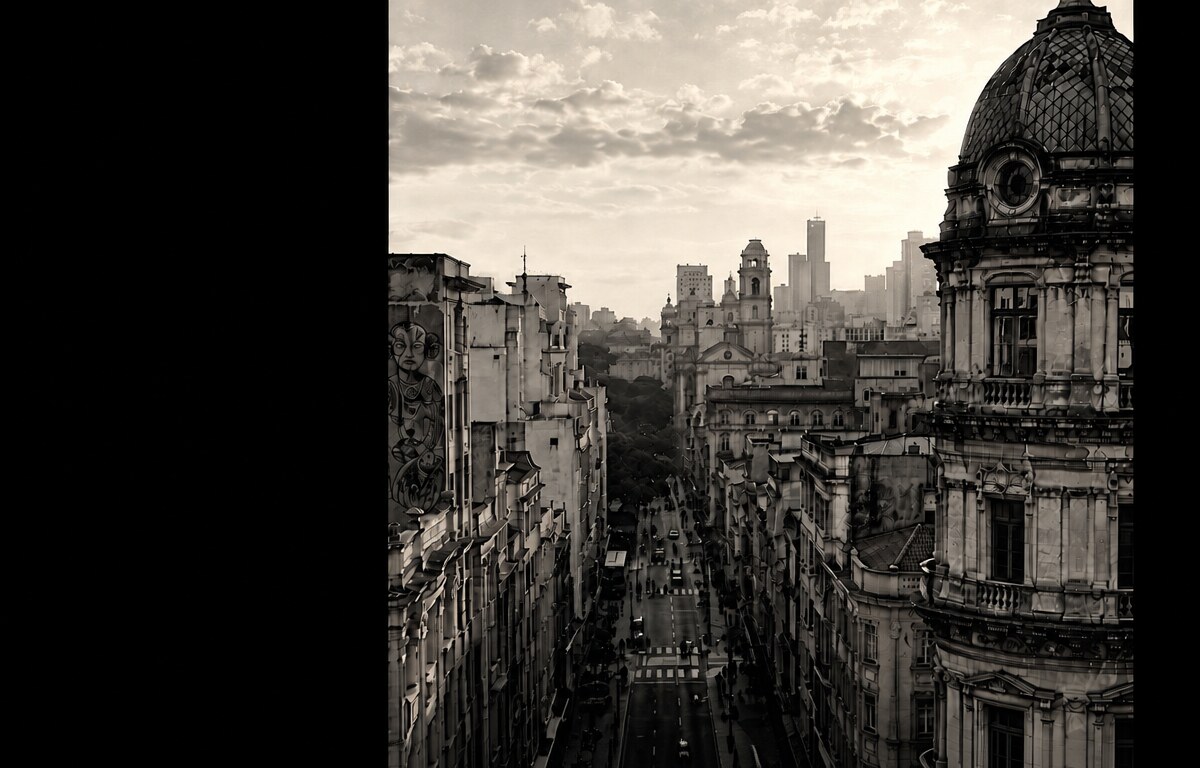
The Day After
INTRODUCTION
The recovery of downtown São Paulo is already underway. Retrofitting, housing, new uses, investment, and public policies are beginning to restore function and foot traffic to a district that lost population, activities, and vitality for decades. But there is a question that goes beyond the physical restoration of buildings: what happens the day after?
This essay takes that question as its starting point to reflect on intangible heritage, memory, everyday culture, and a city's ability to recognize itself again. Because reoccupying buildings is only part of the equation: the real challenge is ensuring that the life returning to them finds identity, belonging, and room for expression. Perhaps this is the next step in the Reactivation Spiral: turning the physical recovery of the area into a cultural and human reactivation capable of sustaining urban transformation itself over the long term.
TEXT
Today in São Paulo, echoes of the past reverberate through the streets and corners of the old downtown. They are voices recalling the bustle of people coming and going, of conversations and encounters in the very heart of the city. After a long period of silence and near abandonment, our old downtown seems to be reemerging through the pulse of human life, through the movement generated by a Reactivation Spiral that promises to bring people, homes, and commercial relationships back to our historic hill and its surroundings.
Through the mutual interests of different players—the municipal government, civil society, and private enterprise—involved in coordinated urban action, retrofitting, housing, and new uses, a New Old Downtown is emerging. This movement first and foremost brings an appreciation of tangible historic heritage, and that is important. São Paulo's legislation already provides specific instruments for the rehabilitation of buildings in the central district. The Requalifica Centro Program, created in 2021, establishes incentives for property rehabilitation, and its regulations were expanded again in 2026, incorporating the entire perimeter of the Central Sector Urban Intervention Area and simplifying procedures to encourage retrofitting. But there is a question that deserves a place in the conversation.
What about intangible heritage?
As far as the instruments we are analyzing show, we have not found, within this same movement of building rehabilitation, an equivalent incentive mechanism specifically intended to sustain and activate intangible cultural production. The point is not to identify a failure or set stakeholders against one another; it is to recognize that restoring an area may require a broader framework of thinking. São Paulo, in fact, has an important history in this relationship between city, culture, and memory.
In 1935, the Department of Culture was created, with Mário de Andrade as its first director. Its mission was not limited to preserving buildings: it included folklore research, surveys, children's parks, libraries, music, iconography, publications, and other ways of understanding culture as an expression of the city's life. The institutional history of São Paulo's heritage itself demonstrates this broadening of perspective. The Department of Historical Heritage, created in 1975, also began working with the idea of the city as a cultural document, incorporating landscapes, different phases of settlement, and inhabitants' relationship with the territory. Its current responsibilities even include fostering public participation in identifying, preserving, and valuing tangible and intangible cultural heritage. This history helps us formulate the question I consider essential: what about the day after?
As urban infrastructure is restored, mobility improves, safety and public-space maintenance advance, and buildings are rehabilitated for housing, commerce, services, and new facilities, people will return to downtown. With them will also return the encounters, sounds, small businesses, cultural expressions, habits, and relationships that give the place its everyday meaning. This is the point at which heritage ceases to be merely what needs to be preserved and becomes what needs to remain alive.
A restored building can recover its architecture. A square can recover its landscape. A street can recover its foot traffic. But who recovers the everyday memory that made that place a point of reference for those who lived, worked, created, and met there? This dimension cannot be addressed through construction work alone. It depends on people, cultural initiatives, entrepreneurs, associations, artists, shopkeepers, residents, and public policies capable of understanding that culture is also a way of occupying a territory.
The challenge, therefore, is not simply to bring people back downtown. It is to create conditions for those people to build new relationships with it, because belonging does not arise from physical presence alone: it arises from experience. And this is precisely where downtown's recovery can move toward a deeper dimension. Tangible heritage can provide the structure; intangible heritage can restore meaning. One sustains the other. It is not a matter of choosing between culture and the economy, preservation and transformation, heritage and new uses. It is a matter of understanding that these elements can form a single urban dynamic.
An active business helps keep a street alive. A living street encourages people to stay. Staying creates relationships, relationships produce memory, memory strengthens belonging, and belonging creates value for the area itself. It is a spiral.
That is why perhaps the next step in the Reactivation Spiral, discussed in Notebook 6, is precisely this: understanding that the physical recovery of downtown is the beginning of a process, not its destination. The day after will be the moment when we discover whether we have restored only the buildings or have also managed to restore the life that gives them meaning.
And perhaps it is in this transition, from recovery to lasting presence, from construction work to experience, from tangible heritage to living culture, that one of the greatest opportunities lies for São Paulo's New Old Downtown.
