November 7, 2026
They’ll Fix It
Memory, heritage, and how we look at what has been left behind.
November 7, 2026
Memory, heritage, and how we look at what has been left behind.
They’ll Fix It
INTRODUCTION
Since boyhood, I have carried a way of looking that may have defined much of my path: when faced with something beautiful, I was enchanted; when faced with something run-down, neglected, or “out of place,” I thought: “They’ll fix it.” Decades later, returning to Galeria Metrópole in downtown São Paulo, I encountered that boy again—and realized that the phrase could no longer be the same.
The Galeria remains an extraordinary piece of modernist heritage, now swept up in a movement of reinvention linked to the creative economy. But it also reveals the marks of decades of abandonment and of an often extractive relationship with heritage. This text grew out of that visit, that childhood memory, and that unease: a text about memory, heritage, the city, and, above all, the act of looking—the gaze that first notices and perhaps one day becomes responsibility.
And you, what do you see when you look at what has been left behind?
TEXT
From a very young age, I accompanied my father on road trips, watching the world rush past through windows on wheels. Just as I was spellbound by natural landscapes, vegetation, animals, and life unfolding along the roadsides, I also developed the instinctive habit of noticing what was “out of place,” things that were neglected, run-down, ugly, or broken. And then I would say to myself, as though trying to soothe that unease: “They’ll fix it.”
That feeling grew with me and accompanied me on my wanderings through the depths of Brazil: the Amazon, Central Brazil, the North, the Northeast, and the South. Roads, cities, small communities, landscapes transformed by human settlement. Nothing seemed to escape that gaze, which, even as it delighted in what it found, also sought out what had been forgotten, abandoned, or simply set aside. Perhaps this is one of the roots of my professional development, of the interest that led me through the arts, design, architecture, interiors, landscaping, and, later, heritage and hospitality as well. After all, if “they didn’t fix it,” perhaps I am the one who should do something about it.
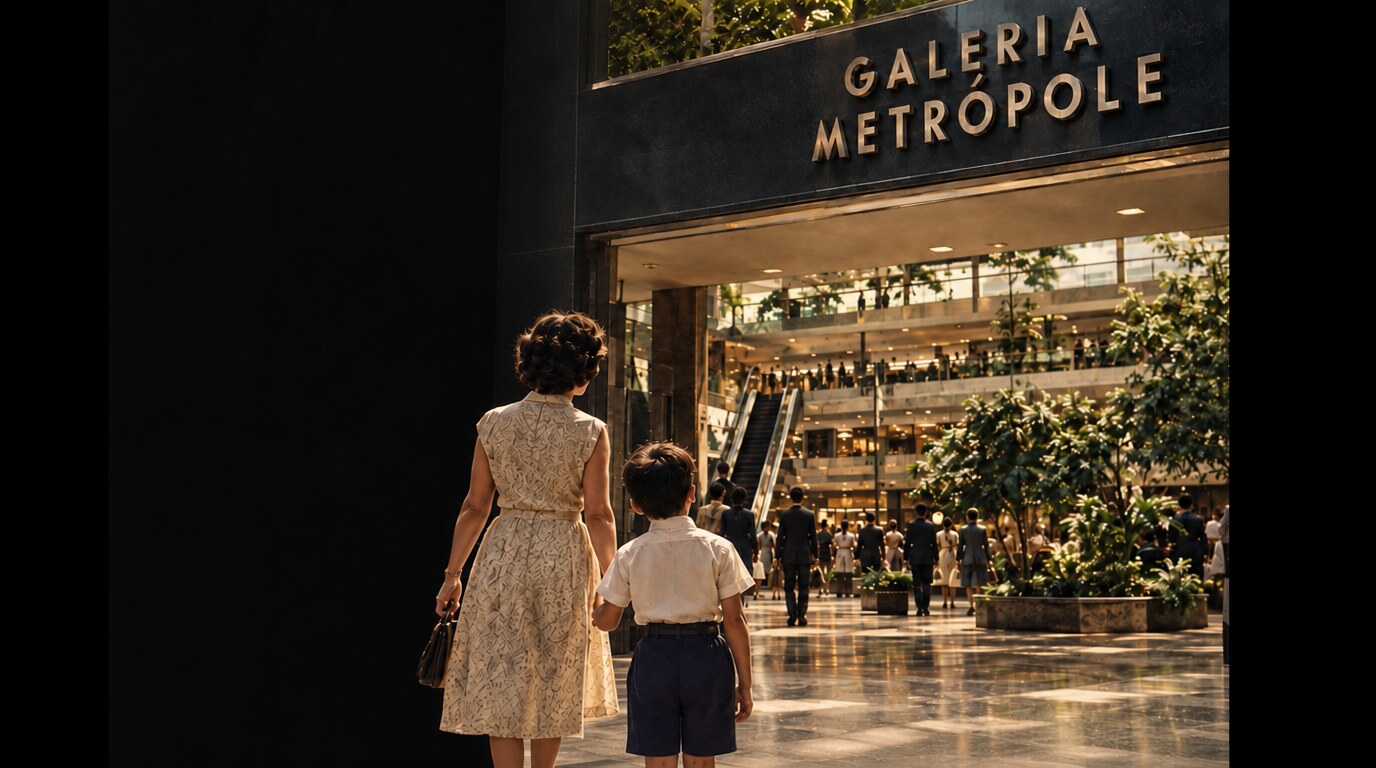
I have vague memories of passing through the then newly opened Galeria Metrópole as a small child, in downtown São Paulo, on Praça Dom José Gaspar, between Avenida São Luís, Rua Sete de Abril, and the surrounding streets, next to Biblioteca Mário de Andrade. It was an extraordinary place for a child. Luxury shops, bars, nightclubs, and restaurants, generous entrances from several streets, fourteen escalators, a large open-air interior garden, and the glorious Cine Metrópole. In the 1960s and early 1970s, the Galeria was one of the sophisticated gathering places of São Paulo's elite, also frequented by university students, intellectuals, and artists. I remember arriving there holding my mother's hand. These are fragmented memories, as a child's memories usually are, but the feeling remained.
From the mid-1970s onward, with the deterioration of downtown, rising crime, and the arrival of shopping malls, the Galeria lost its glamour. Luxury shops were gradually replaced by travel agencies, currency exchanges, self-service restaurants, and more basic services. Decades later, in the 2010s, there was another attempt at revival, with bars and clubs such as Grand Metrópole and Mandíbula, along with cultural spaces such as the Tapera Taperá bookstore. More recently, after the pandemic, design studios, ateliers, art galleries, secondhand shops, cafés, and independent brands began to appear, accompanied by fairs and events. The Galeria then came to be seen once again as a kind of modernist oasis in downtown São Paulo, preserving its architecture and its interior garden.
A few days ago, I returned to Galeria Metrópole. I went to see this movement of reinvention up close, and even before noticing what was new, something curious happened: the boy returned. That boy who arrived there holding his mother's hand. So did the excitement of rediscovering the feeling I had kept tucked away since childhood. But along with him came the old habit of looking. Once again, I began noticing what was “out of place,” things that were neglected, what was run-down, what could be better, what was ugly, and what was broken. And this time I could no longer say to myself, as I did as a child: “They’ll fix it.”
Because today I know some things that boy did not. After decades working with the market, with real estate and its entire ecosystem, I realized that often it is not that they were unable to fix things. It is that they did not want to. Or perhaps they did not understand why they should.
It is common for the value of cultural heritage to go unrecognized. Space is treated in an extractive way: what matters is what it can produce, what it can yield, what can be exploited. Often, little importance is given to what it represents—its history, its architecture, its memory, its ability to create belonging. And perhaps that is precisely where the greatest waste lies.
Galeria Metrópole is still there. It still exists. It still has its architecture, its garden, its spaces, its proportions, its memory. And there is also something new happening: ateliers, studios, cafés, galleries, secondhand shops, independent brands, events, people creating and occupying that space again. It is possible that the creative economy is finding a new possibility for life there.
But reinvention does not automatically erase deterioration. There is still much to care for, much to restore, much to notice. And perhaps this is precisely the most interesting part of the story, because restoring a heritage site should not simply mean repairing walls, replacing finishes, or painting façades. It should mean recognizing the value of what already exists and allowing that value to generate a future once again.
When I left the Galeria, I kept thinking about that boy. He knew nothing about heritage. He knew nothing about real estate. He knew nothing about the creative economy. He could not even explain why some beautiful things enchanted him and others, when neglected, made him uneasy. He simply looked. And perhaps it was that gaze that brought me here.
Today, decades later, I am still looking. The difference is that now I know that looking can also be a form of responsibility. That is why I want to keep believing that Galeria Metrópole can reinvent itself; that this heritage can once again be recognized for the value it holds; that the people occupying its spaces today can build a new layer of its history.
And that someday a boy will pass through, perhaps holding his mother's hand, look at that place and, faced with something that was once run-down, be able to think, with the same hope I had as a child:
“They managed to fix it.”
