November 7, 2026
Beyond the Numbers
A new perspective on risk, return, and urban transformation.
November 7, 2026
A new perspective on risk, return, and urban transformation.
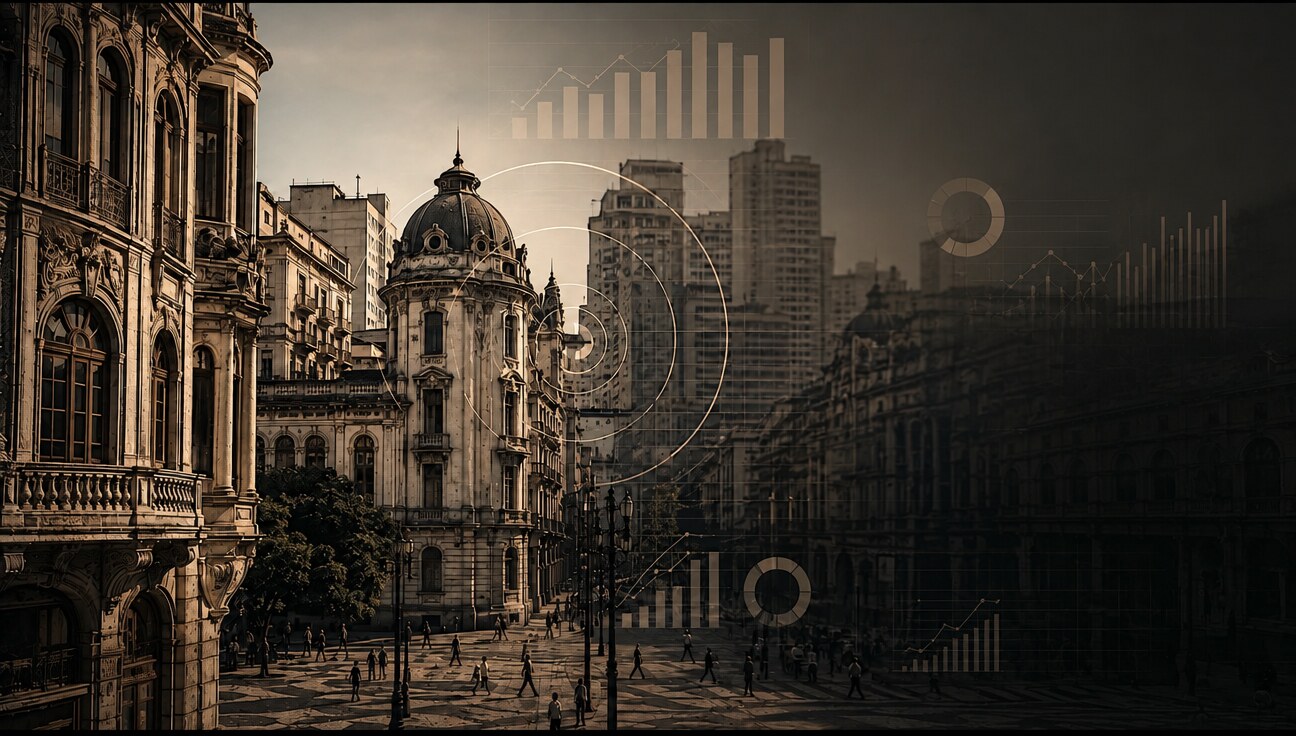
Beyond the Numbers
INTRODUCTION
Beyond the Numbers proposes a reflection on how we assess risk, return, and opportunities in urban transformation. Without questioning financial rationality, the essay challenges us to broaden our framework of thinking: what if, beyond the return on the asset, we also considered the value created for the area and for people? The regeneration of run-down areas can generate effects that extend beyond the spreadsheet: foot traffic, economic activity, employment, belonging, well-being, productivity, urban quality, and new investment. In downtown São Paulo, this perspective takes on particular relevance.
Going beyond the numbers does not mean abandoning them. It means recognizing that transforming a city creates forms of value that do not always fit immediately into a spreadsheet.
TEXT
There is a question that precedes practically every investment decision: how much will this return? The question is legitimate. Capital must earn a return, risk must be assessed, and the operation must demonstrate its viability. In the real estate market, this means analyzing acquisition, cost of capital, investment, demand, liquidity, payback, rate of return, and countless other variables. The market needs to do the math. Perhaps the question is a different one: are we doing all the math?
When we look at the regeneration of run-down urban areas, especially historic districts such as downtown São Paulo, we encounter a far more complex equation. There are vacant properties, carrying costs, substantial investment requirements, financing constraints, regulatory issues, and uncertainties surrounding demand. Public authorities face budgetary and institutional limitations; the real estate market must meet its viability indicators; financial institutions must protect capital and manage risks. Each player has its own logic, and the challenge lies in enabling these different logics to converge.
There is, however, a contradiction worth examining. The financial market works constantly with the future. Projections, scenarios, expectations, valuation, and different investment instruments exist precisely because capital seeks to anticipate what has not yet happened. The future, when converted into a financial variable, can be analyzed, priced, and managed. But when that same future must be physically built in a place, through the restoration of a building or the transformation of an urban area, much greater caution often emerges.
Why can the future be an investment opportunity when it is financial, yet seem excessively risky when it needs to be built in the city?
This is not to say that urban regeneration carries no risks. It does: there are risks involving execution, financing, demand, costs, permitting, and operation. Perhaps the question is a different one: what is the risk of doing nothing? An empty building also carries a cost. An abandoned property continues to generate expenses, deterioration, and opportunity costs. A run-down district produces effects that extend beyond the boundaries of a property: it reduces foot traffic, weakens economic activity, discourages investment, affects perceptions of safety, and contributes to the progressive loss of value of the area itself. Inertia is also a decision and should therefore also be part of the calculation.
When an abandoned asset is restored, something greater can happen than simply an increase in its value. A building can once again accommodate residents, offices, shops, services, or cultural facilities. People begin moving through the area again. Foot traffic generates consumption, consumption sustains businesses, businesses generate jobs, and jobs attract people. Human presence encourages new businesses, and new businesses stimulate new investment.
This is where the Reactivation Spiral, presented in Notebook 6, takes on a new dimension. Memory, experience, belonging, and the economy are not independent elements; they can feed one another. Restoring a place can restore its meaning; meaning can create belonging; belonging can encourage people to stay and use the place; use can generate economic activity; and economic activity can create conditions for new investment. It is not simply a matter of restoring an asset. It is a matter of creating the conditions for it to generate life again.
But there is another variable that frequently plays a secondary role in economic analyses: the quality of the environment and its impact on people. Well-designed workplaces, with spatial quality, comfort, lighting, ergonomics, and well-being, can encourage concentration, satisfaction, and productivity. High-quality urban environments also affect how people live, move around, and relate to the city. When the quality of experience improves, its effects can extend beyond the individual sphere to how long people stay, consumption, productivity, and, ultimately, value creation.
This means that architecture, culture, heritage, and spatial quality should not be understood merely as accessories to a real estate operation. They can contribute to value creation itself. Beauty is not simply an aesthetic matter: it can be an indirect economic variable, because it influences human experience. A well-designed space can make people want to stay, work, live, spend, and return. And when people want to be in a place, economic opportunities emerge.
This is where we may need to bring about a turning point in our framework of thinking. It is not a matter of replacing financial rationality with a romantic view of the city, nor of imagining that culture, heritage, or architecture can dispense with economic viability. The movement is precisely the opposite: broadening the framework by incorporating into the analysis what happens after the investment begins to have effects on the area and on people. Perhaps a development's return need not be measured solely by the results achieved by the asset that received the investment. There is also the return generated by the surrounding area, by economic activity, by urban quality, by experience, by belonging, and by the ability to attract new flows.
This change requires convergence among different stakeholders. Public authorities can create conditions through regulation, infrastructure, incentives, and urban policies. Financial capital can structure investments and manage risks. The real estate sector can transform assets, and construction can make that transformation tangible. Architecture and culture can give space meaning and quality; operations can create experience. And the citizen is the one who ultimately experiences the result. Urban regeneration is not the responsibility of a single sector: it is an opportunity shared by different sectors.
In downtown São Paulo, this issue takes on an even greater dimension. Restoring buildings, creating housing, encouraging economic activity, expanding cultural facilities, and bringing foot traffic back to the district means much more than restoring real estate assets. It means reconnecting the city to the place where it was born.
When someone walks through a run-down area, they do not experience merely a real estate problem. They experience the city, and the everyday experience of abandonment affects their relationship with that place. Likewise, when they encounter a restored space that is alive, beautiful, occupied, and meaningful, the experience is different. Perhaps this is the variable still missing from many calculations: the value of restoring dignity to a place.
This value does not replace financial return. On the contrary, it can help produce it. A higher-quality city attracts people; people generate movement; movement generates activity; activity generates economic life; economic life stimulates investment. The transformation of an area can create a sequence of returns that extends beyond the initial asset.
Beyond the Numbers does not mean being against numbers. It means recognizing that numbers are part of reality, but they are not the whole of reality. A city is simultaneously heritage, infrastructure, an asset, a territory, an experience, memory, a market, and, above all, a space for human life.
Perhaps the urban future does not need less calculation. It needs a more encompassing calculation: one that considers investment, return, and risk, but can also recognize what happens when a place begins to generate life again. Because the true value of an urban asset lies not only in what it is worth when it is bought, sold, or entered in the accounts. It also lies in what it can make happen around it.
Going beyond the numbers does not mean abandoning them. It means broadening our framework of thinking to understand everything that numbers alone still cannot tell us.
